
Deep Lore: Setting Overview - Arroyo
All About the City of Bridges and Briars
Where It All Began. Where to Begin?
The web serial that inspired Anno Amagium: The RPG is primarily set in the city Arroyo, based on Hank's hometown, Pasadena, California.
Like Pasadena, Arroyo is an expansive, verdant suburb existing in Los Angeles' eastern shadow. Both cities were home to an arts and crafts movement that has yielded beautiful architecture, pottery, and stained glass. Their histories are deeply intwined in scientific progress and New Age, supernatural experimentation. On the surface, Pasadena and its amagiate doppelgänger are peaceful and picturesque, but like any city, crimes are committed behind closed doors and in the streets, by highly organized groups and isolated individuals. Both cities are defined by tremendous privilege, contrasted against pockets of poverty that shift with the ebb and flow of gentrification.
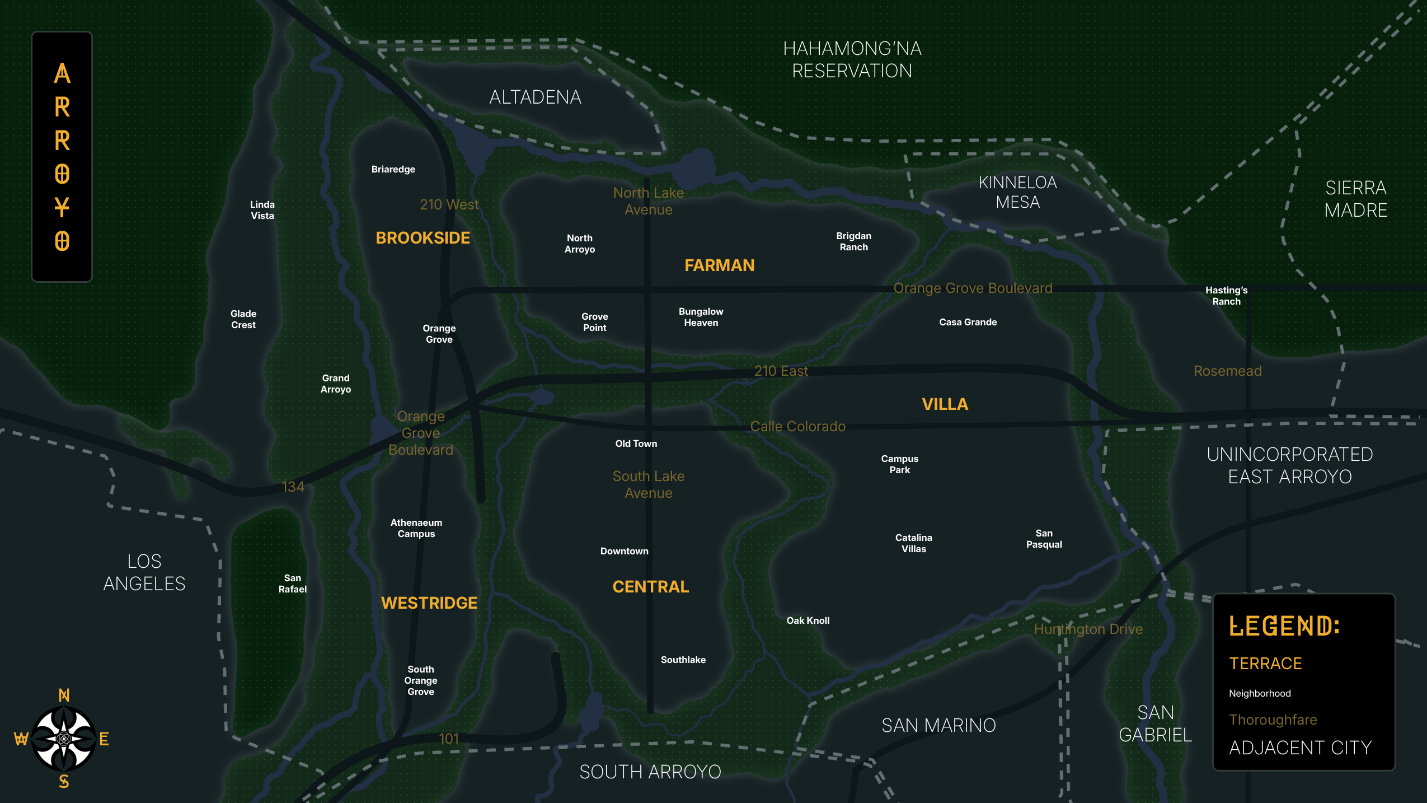
But Arroyo is also more than Pasadena. It has been magnified and warped by Alice's magic looking glass, making substantial changes to the city's geography such as the petrified rose briar, a colossus on the scale of Jack's giant beanstalk. This stone bramble and its crystalline roses stretch throughout the city's multiple green gulches (as opposed to Pasadena's singular arroyo), separating the city into five distinct "terraces" of land that serve as urban centers. These broad mesas are connected by a multitude of architecturally marvelous bridges, the most famous being the Calle Colorado Bridge. To the north of the city proper, there is a completely fictional region between the Arroyo Seco and the San Gabriel foothills that houses a small First People's Reservation—a byproduct of the Pacific States of Ericia and United Tribes' shared alternate history. This addition introduces a number of unique storytelling opportunities, including jurisdictional complexities, cultural tensions, and indigenous supernatural intrigue.
Arroyo is at its best when these fanciful trappings intersect with elements of Pasadena's real history, however. Jotham Farman (based on the wonderfully real Jack Parsons) was a man of many hats, becoming a pivotal figure in the Space Race as well as conducting a number of mysterious supernatural experiments in the Devil's Gate reservoir whose consequences still reverberate throughout the city's leylines and supernatural climate to present day. To locals, the famous Calle Colorado Bridge is known as the Suicide Bridge (like its Pasadena counterpart), introducing all sorts of opportunities for curses, hauntings, and dark rituals.
How "Crown City" Earned Its First Nickname
In brief: what is now the City of Arroyo changed hands many times before it resembles the current setting. The Hahamong'na family of the Tongva Tribe was converted to Christianity and subsequently claimed by the Colonial Spanish. The Mexican Empire declared its independence from Spain shortly thereafter, but the territory was swiftly re-claimed by the New Atlantic Sovereignty… Just before Pacific States and United Tribes simultaneously declared their secession. At that point, the so-called Crown City was "passed" to the Pacific States, however the area itself was technically "owned" by the United Tribes. As part of their joint secession, the Hahamong'na First Peoples would receive Reservations of Land in the Pacific States as a bulwark against cultural erasure. In theory, anyway.
The Hahamong'na Reservation persists to this day, albeit outside of Arroyo proper, severed from the briar that gave the First Peoples shade. What's left of the Reservation is a stretch of land that has been generously categorized as "forested," extending up to and including the foothills. It has been likened to a "social release valve" for Arroyo, and less charitably characterized as the city's "liver," as residents often cross the border to "cut loose," while outright criminals often exploit the area's jurisdictional technicalities. The Reservation itself has steadily shrunk throughout the years according to repeated "Demographic Reassessments" of the area, as its former territories gradually gentrified, and the Native Erician heritage of its people steadily diluted. What remains is largely impoverished and under-policed, save for an infamous resort casino: Silver Canyon Springs, or "Little Vegas," as it is known in Arroyo and Los Angeles.
Oldest Money on the West Coast
Drawn by the favorable climate and enchanting landscape, vacationers from the New Atlantic Union—some of the richest people in the world at the time—commissioned lavish estates on the outskirts of the reservation. This money mingled with Gold Rush gilt and Hollywood glam to make the city what it is today. It's official incorporation date (2231) was driven by a (heinously hypocritical) push from the Temperance Movement to push the saloon (and its then-undesirable neighborhood, originally dubbed "The Liquor District") outside of the city limits. This region was swiftly reincorporated into the city following the first demographic reassessment of the Hahamong'na Reservation, shortly after Ericia's collective repeal of Prohibition.
Wealthy industrialists steadily flocked to the city, lending their fortunes and names to a number of institutions around town. Gamble Memorial Hospital and the Gamble Gardens and Library were funded by the development of railroad magnate Devnam B. Gamble, whose trains brought scores of tourists and a healthy flow of commerce to the fledgling city. Famous architects, such as Cohen & Cohen and Kubrick built magnum opuses in the forms of craftsman-style bungalows and mansions. These various features combine to give the city a sense of heritage that is unrivaled on the West Coast.
The Great Depression struck Arroyo less severely than much of Ericia but still devastated its tourism industry and shuttered many businesses. The city's fortunes quickly reversed during the second half of the Great War, when its scientific institutions became critical to military research and development. Hotels throughout Central Terrace were converted into military HQs, and Arroyo cemented its reputation as a nexus of technological innovation.
Science & Scholarship
In the late Inter-Amagiate period, the city housed the Ambassador College for Magical Warfare, which served as the Erician Alliances' premiere training ground for Erician battle mages in the Great War. Another storied institution, Westridge University for Lady Magi, located on the southeast side of the terrace, developed the founding principles of modern medithurgy. Shortly after the global conflict's conclusion, the two schools formed a brain trust and converted Ambassador's campus into one of the Third Amagium's first Athenaeums in Ericia. The campus has grown steadily throughout the years, dominating the northwest edge of Westridge terrace like a small city unto itself, with one of the Amagium's Grand Archives serving as its centerpiece. Westridge University also continues to thrive, though it is now an asfalis institution.
Other non-magical places of learning include the California Institute of Technology (Caltech to locals), and Jet Propulsion Laboratory (JPL) just to the south of Altadena and the Hahamong'na Reservation. Arroyo's greatest local hero, Jotham Farman, was a pioneering rocket scientist, founding member of JPL, and self-taught Arcanist, and who helped propel humanity into space while championing technological achievement over magical shortcuts. He is also widely credited with kickstarting the development of the celebrated Bungalow Heaven neighborhood in Arroyo's northmost terrace, which now bears his namesake.
Landmarks, Secrets, and Other Curiosities
In addition to his civic and scientific contributions, Farman conducted a number of occult experiments, probing the depths of the storied Devil's Gate Reservoir, the mysterious Proctor Estate, and the Calle Colorado Bridge. Farman's colleagues and contemporaries included new age religious leaders including the infamous Alanastor Crowley of Thelema and Elrandell Hubbard, founder of The Church of Scientology. Many myths abound about these new age luminaries, including Alanastor's claims that he helped Farman open a portal to an unknown plane of existence, and siphoned its foreign energy to produce an artificial leyline in the Arroyo Secco, and their joint conjuration of an "Elemental Woman" known as Babalon, supposedly destined to overturn the current epoch of man.
Another world-famous supernatural landmark is the Avaltician Church of the Rose Knell Bridge. A syncretic faith merging protestant Christianity and Irish pagan traditions of Fae worship, Avalticianism has relatively few practitioners, and its most famous church is actually built into the undercroft of Arroyo's Rose Knell Bridge. It became an Erician landmark after an entire congregation mysteriously vanished in 2258 prompting a closure and decades long investigation that proved inconclusive. Shortly after the church reopened, a second mass disappearance occurred in 2285. The sensational media coverage of these events has inspired thousands of stories and conspiracy theories over the years and remains one of the world's foremost supernatural tourist attractions.
A less well-known legend is perched on the San Gabriel foothills in the unincorporated Kinneloa Mesa area. Northridge Manor, an estate converted into an insane asylum, was consumed by a violent wild fire in 2338. Witnesses claim that while the rest of the region was subject to normal blazes, the asylum burned with black flames at an unnatural speed, leaving no survivors. Over the years, a number of strange deaths have been reported in the neighborhood, along with claims that the Asylum periodically reappears on its former foundation at night, as if it had never burned to the ground.
The Pacific Seat of the Third Amagium
Given its age, wealth, and abundance of supernatural activity, it is a small wonder that Arroyo's Athenaeum stands as the Third Amagium's most important enclave on Ericia's west coast. While New Amsterdam's sprawling complexes are traditionally treated as the amagiate "Erician Mecca," a greater number of famous Amagiate bloodlines call Arroyo home, including the Valmont and Hughes families. This backdrop readily lends itself to players looking for heroic pedigrees, and for those who want to play political games with the Third Amagium as a whole.
It is also worth noting that the Arroyo's Athenaeum Campus is less integrated into the city than most of Newam's institutions, resulting in sharper social divisions between asfalis and amagiate civilians, and more frequent clashes with Anticordant (anti-Amagiate) protestors or acts of outright terrorism committed by violent extremists like The Unbranded. Fate Masters eager to explore social dynamics between asfalis and amagiate life will be well-served by Arroyo.
An Ideal Point of Entry
Neither a small, isolated city like Dalhart, nor a mega-metropolis like New Amsterdam, Arroyo is a suburban middle ground that many players will find familiar, making it ideal for easing people into the system and the world. It is the most flexible of our first three settings, accommodating intimate mysteries and sprawling epics with global stakes. Given its proximity to Hollywood, Arroyo is particularly well-suited for cases that explore the fickle nature of fame, the excesses of celebrity, and the dark side of the entertainment industry.
If you are interested in learning more about Arroyo, we strongly recommend reading our lore book, which covers the city's history in greater detail.