
Deep Lore: Setting Overview - New Amsterdam
All about the Global Crossroads
The City That Doesn't Sleep—or Stop Growing
Welcome to the greatest city in the world.
Welcome to an urban forest where skyscrapers rise higher than mountains, only for parks, plazas, shopping centers, apartment complexes, and entire neighborhoods to be built across their upper floors. Welcome to streets that remain crowded at every hour, subways that descend into forgotten tunnels, and golden rivers of ether that carry airships between the towers.
Welcome to New Amsterdam. Try to keep up.
Known affectionately—or simply efficiently—as Newam, New Amsterdam is one of the largest, wealthiest, most influential cities in the world. Like the New York City that inspired it, Newam exists at the forefront of international trade, fashion, cuisine, finance, crime, architecture, and the performing arts. It is aggressively alive, relentlessly competitive, and forever tearing itself apart to build something taller in the same place.
Newam's skyline is transformed by Cavoralis Currents, golden streams of air-aligned ether that flow through the city and its surrounding regions. These currents allow airships, ferries, taxis, and private commuter craft to move between ubiquitous sky docks. Buildings do not merely scrape the sky; they connect across it, supporting elevated streets and neighborhoods high above the original ground level. The result is a city that feels as much like science fiction as fantasy.
It is also a city constructed upon staggering inequality. The wealthiest Newamers inhabit gleaming towers and private aerial districts, while residents below may receive only the scraps of sunlight that filter through layers of steel, stone, and suspended infrastructure. Opportunity is everywhere, but so is competition. Newam will give almost anyone a place to belong—provided they can compete with the best of the best and the lowest of the low.
A Name Too Powerful to Change
The earliest known inhabitants of the region were the Lenape Tribe, who cultivated the land and harvested the Atlantic long before European colonization. Dutch explorers established Fort Amsterdam in 1970 AA, incorporating the surrounding settlement as New Amsterdam through an archaic Sacred Naming ritual. Forty years later, British forces seized the city and intended to rename it New York. They even prepared new maps.
There was only one problem: the Dutch had woven the city's defenses around the magical and cultural significance of its Sacred Name. Changing it would have meant rebuilding its wards from the ground up. The British decided that colonial pride was considerably less important than functional magical fortifications, and New Amsterdam remained New Amsterdam.
Newam subsequently became one of the central battlegrounds of the Erician Revolution. The Battle of Golden Hill is widely considered the conflict's first battle, while the eventual British withdrawal from the city marked the end of the war. New Amsterdam even briefly served as the capital of the newly established New Atlantic Sovereignty.
Its importance only grew after the Civil War. The Erie Canal transformed Newam into a juggernaut of international commerce, while waves of immigrant labor built public works such as Central Park and the Brooklyn Bridge. Universities and museums accumulated archives filled with grimoires and magical artifacts. Asfalis scholars studied spellcraft with unprecedented rigor, while practical developments in artifice transformed Newam into what newspapers began calling “The Magic Capital of the World.”
Ellis Island opened in 2237 and became the largest Lexiclave in recorded history. New arrivals were documented according to their trades and magical abilities, issued appropriate licenses, and educated about Erician magical law. Generations of immigrants passed through its halls, adding their languages, customs, cuisines, spells, and spirits to a city that was already becoming impossible to summarize.
The High Wind Era
Newam's skies were not always full.
The city established its first sky-ferry program during the Final War in 2287. Though presented as a public transportation project, the program had a secondary military purpose: air-cab pilots were required to undergo dogfighting exercises before receiving their medallions, allowing them to serve as an improvised aerial militia in the event of invasion.
The expected invasion never came, but the ferries stayed.
Newam's resulting High Wind Era produced an explosion of aerial artifice, gravity-defying architecture, sky docks, elevated districts, and commuter craft. The city's innovations spread outward, but few other regions possess Cavoralis Currents powerful enough to recreate Newam's airborne infrastructure at the same scale.
At the same time, Amagiate-sanctioned symvision networks strengthened Newam's already considerable influence over global media. Broadway entered a golden age. Galleries became battlegrounds for successive artistic movements. The city became not only a place where culture was produced, but where the world was told what culture would become next.
A City That Dreams Its Own Monsters
New Amsterdam's dense population leaves relatively little room for conventional monstrum to establish nests. The exceptions tend to be dire vermin in abandoned subway tunnels, human-presenting creatures capable of disappearing into crowds, and colossal Kaiju emerging from the Atlantic.
Egregores are another matter.
Newam's collective unconscious is unusually thick and mercurial. Trends, fears, rumors, and urban legends can accumulate enough psychic momentum to become independent entities. In a city of eight and a half million people, an idea does not need to be true to become powerful. It only needs to spread.
The most famous of these entities appeared in 2305, when a human-sized manifestation of the Statue of Liberty emerged on Liberty Island. She possessed memories reaching back to the monument's construction, a deep understanding of Erician history, and the ability to bestow minor blessings of good fortune. Though visitors quickly dubbed her the “Goddess of Ericia,” Liberty herself rejected the title, warning that it was bad luck to call oneself a god.
Following extensive study, Liberty became the first nonreligious egregore to receive formal recognition and legal exemption from the Third Amagium.
Not all of Newam's living stories are so benevolent.
During the summer of 2322, a police strike, citywide blackout, rising street violence, and the arrival of the Black-Ridged Beast produced an unprecedented surge of dangerous egregores. As the Keeping Force approached collapse, asfalis vigilantes cracked their magic licenses and took to the streets in imitation of comic-book superheroes. A handful became genuine heroes. Most became another part of the problem.
The resulting Terrors of '22 permanently shaped Newam's reputation as a city of masked vigilantes, monstrous crime, and pulp heroism.
The city endured an even greater tragedy on 10/28/2346, when coordinated terrorist attacks destroyed the World Trade Center and caused hundreds of additional aerial collisions. The attackers intended the catastrophe to generate enough fear and grief to overwhelm Newam with egregoric chaos. Instead, its first responders and Guardians prevented a second supernatural disaster, further concentrating the fierce civic identity of those who call themselves citizens of “Ericia's First City.”
Five Boroughs, Infinite Cities
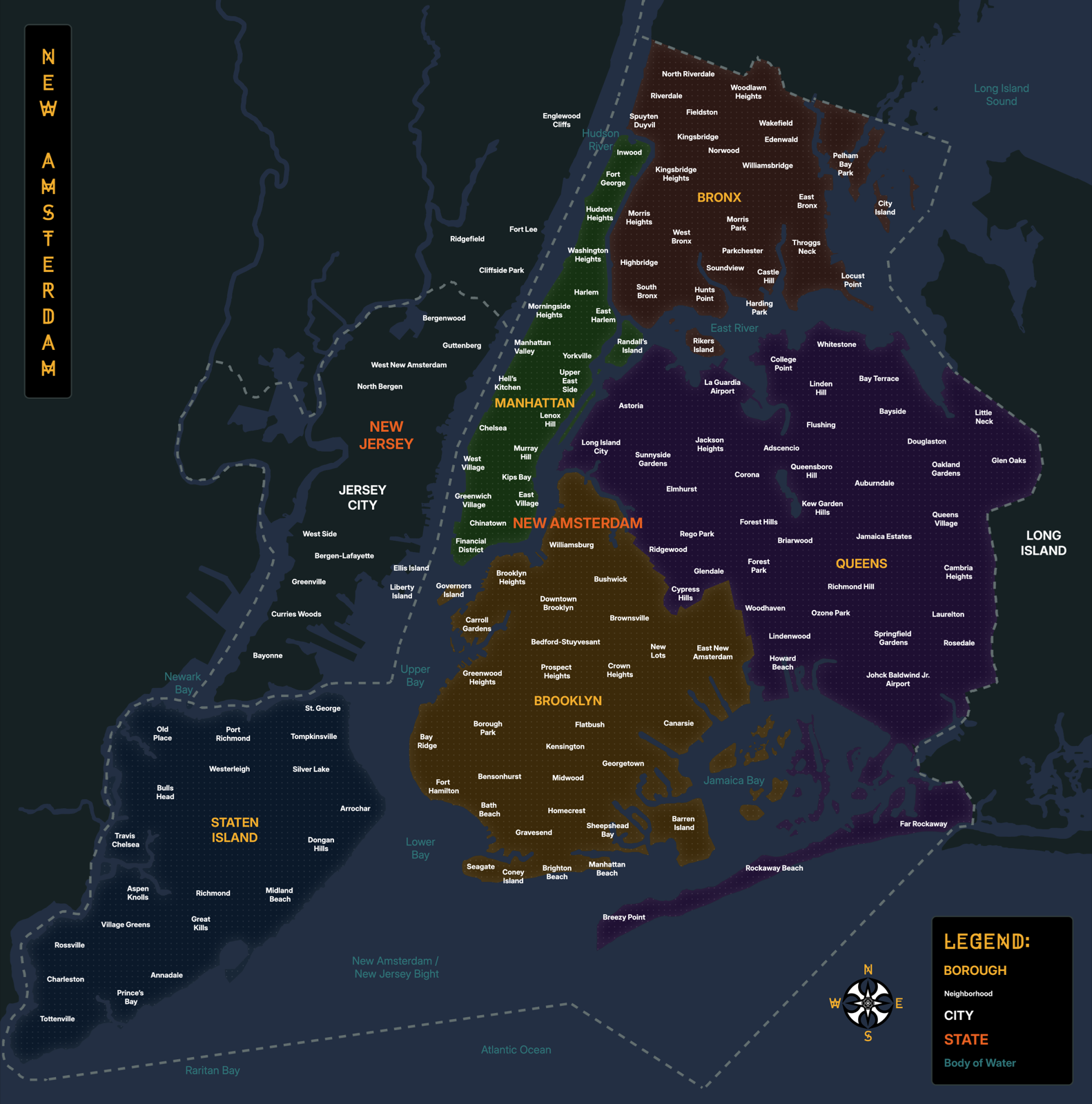
New Amsterdam's eight and a half million residents are distributed across five boroughs, each containing more neighborhoods, subcultures, institutions, and local histories than most ordinary cities. The setting's map reflects that metropolitan scale, dividing Newam between the Bronx, Brooklyn, Manhattan, Queens, and Staten Island, with Hudson New Jersey and Long Island pressed tightly against its borders.
The Bronx is Newam's northernmost and arguably least Amagiate borough. Its Cavoralis Currents are thinner, its skyline less gravity-defying, and its Keeping Force presence smaller than elsewhere in the city. Nevertheless, the Bronx was the birthplace of urban essentialism—the practice of drawing ether directly from metropolitan environments—and remains a major center of hedge magic.
Brooklyn is Newam's most populous borough, known for its brownstones, artistic communities, ethnic enclaves, and seemingly perpetual cycles of gentrification. Its historic homes contain some of the world's most complex surviving pre-Amagiate enchantments. The Brooklyn Bridge—also called the Twofold Bridge—contains the only known fixed passage into New Arcadia, the largest city of the Faed. Coney Island, meanwhile, hosts a world-famous amusement park suspended above the coastline by Cavoralis Currents.
Manhattan is the Newam most outsiders imagine: a forest of iconic towers, aerial parades, elevated neighborhoods, and world-famous landmarks. It also contains the Third Amagium's largest Athenaeum campus and archive. Egregoric activity is denser there than anywhere else in the city, and Kaiju attack Manhattan more frequently than any other borough for reasons that remain poorly understood.
Queens possesses an unusually thin and permeable Veil, particularly in its parks. Fae incursions, trans-planar smugglers, magical contraband, and illegal “Night Bazaars” are common. It also contains Adscencio, a municipal district governed as Amagiate territory and used as Ericia's only public testing ground for proposed asfalis magical exemptions. Predictably, magical accidents are frequent.
Staten Island, the safest and least densely populated borough, lacks much of Newam's famous aerial congestion and elevated architecture. It compensates with supernatural weather, classified research, and persistent rumors. The Amagium's Crucible facility conducts advanced experiments from the island's Observatory Spire, while the surrounding woods produce regular monstrum sightings and stories of the infamous Cropsey. Transmutation storms and errant Witch Streams are common enough to make portions of the island's airspace virtually unnavigable.
Landmarks, Secrets, and Other Curiosities
Newam may possess five recognized boroughs, but several impossible histories insist that it once had nine.
Books discovered in the archives of Columbia University and New Amsterdam University repeatedly describe four additional boroughs named New Angthom, Polistrome, West York, and Eastmarque. Readers can understand the volumes while looking at them, but cannot reliably remember, transcribe, or speak their contents. Arcanists have also detected evidence suggesting that a landmass of significant size was somehow excised from the Atlantic south of the city.
Nobody knows whether the Lost Boroughs were destroyed, transported, erased from history, or never existed at all.
The surrounding Atlantic presents more immediate dangers. Its waters support smugglers, aquatic monstrum, dire animals, and the world's busiest underwater salvage industry. Kaiju alerts occur almost every week, though only a fraction of the creatures spotted offshore ever make landfall.
The most infamous was the Black-Ridged Beast, a twenty-story crocodilian entity whose intelligence, speed, and resilience made it more dangerous than many larger creatures. Its arrival helped ignite the Terrors of '22 and remains one of the defining supernatural disasters in the city's history.
The Biggest Stage in the World
New Amsterdam is the largest and most open-ended of Anno Amagium's three introductory settings. It is built for stories with towering stakes: Kaiju attacks, Amagiate power struggles, masked heroes, global conspiracies, and characters determined to become famous, make history, or save the world.
But Newam does not demand an apocalypse.
Its infinite neighborhoods can support police procedurals, hardboiled detective stories, supernatural crime dramas, monster-of-the-week adventures, workplace comedies, artistic rivalries, and intimate stories about people struggling to afford rent in the shadow of impossible towers. Its population ensures that any culture, creature, faction, or magical tradition can plausibly pass through the boroughs.
New Amsterdam is too large for any single Fate Master—or any single campaign—to completely define. That is its greatest strength. Every street can hide another community. Every tower can contain another secret. Every subway tunnel can descend into a history the city has paved over and forgotten.
If you are interested in learning more about New Amsterdam, we strongly recommend reading our Universe Guide & Lore, which explores the city's history, boroughs, landmarks, magical infrastructure, and many impossible secrets in greater detail.