
Anno Amagium Development Blog 3: Game Designers' Five-on-Five Concerning Curricula
I ask him 5 questions. He asks me 5 questions. The topic? Curricula. Anything goes.

Hank: Hello again Echelon! I'm the original creator and Lead Game Designer of Anno Amagium. For those who don't know, curricula are the most important building blocks in our character-building system. And today, I am shooting the breeze about them with Colin Solloway, Senior Game Designer and curricula co-creator. We would have recorded this but we both hate the sound of our own voices.
Colin: It's also easier to write our responses out so you don't have to hear/see us hemming and hawing. Plus, it gives me a nice reprieve to write something different than all the Ability and Technique info boxes. I swear they've started haunting my dreams. I'm murmuring "As a Reaction to …", "Roll a … Challenge (100) …", "If an opponent would … you may …" in my sleep. On the bright side, I'm up to 70 words a minute. So that's nice.
Hank: 250 curricula are a lot, especially when you consider each one is a micro-class. You get about as much mechanical juice from a single curriculum as you would from the first-level of a class in uh… Leading Brand TTRPGs. How would you recommend players ease their way into building their first character?
Colin: Really, I think what it comes down to is: pick one thing that sounds cool, maybe look for synergies in some other curricula (like Elemental Weapons and Cardinal Element Magic curricula) and just try to expand from there. I think synergies are a good way to help map out what your character wants to do, and how each curriculum can work together to culminate in something bigger than its' parts.
When I'm designing a curriculum, one of the lenses I often try to view them through is "If I were a player and wanted to make this my core combat system, what would I want to do with it?" And that often helps me design something intricate that can also be looked at on a surface level and enjoyed as a supplementary system.
Hank: Ha, I was gonna ask what you try to capture in curricula next. I think we both tend to start with a thematic concept and extrapolate mechanics from there... what else do you consider?
Colin: I think a lot of it comes from what the curricula would showcase in a thematic way and then integrating those thematics into the rules of the system. I will say, sometimes though you just get an idea of a mechanic and search out a curriculum that would be a good place for it too.
Hank: Yeah, I did the latter with Leximancer. Came up with an idea for a curriculum-specific status effect or condition that abilities could scale off of. And who better to impose clauses and conditions than our programming wizard-lawyers?
Colin: For other considerations, I would say that a key design element is making sure to keep each curriculum fairly unique in terms of how it goes about processing and integrating into the rules. Sure, lots of elemental curricula have a direct damage spell, or a big AoE, but the details they provide in the thematic description hint at how they might affect the world around them in unforeseen, flavorful ways. I think that really showcases their unique designs.
Hank: What are your top three favorite curricula that you've designed?
Colin: Haha, well one for sure is the infamous Qi Marker. I think it has both a really great core design as well as nearly infinite room for growth with homebrew Qi Runes. One of my absolute favorite aspects of game design is modality and this is probably the most modal one I've done so far.
Hank: Yeah, I am also a sucker for modality. Which is why I embraced the ridiculous Qi Marker charts instead of fleeing in terror.
Colin: I think another would be Advanced Soft Shields. You don't see a lot of fencing specific defensive weapon usage in TTRPGs and given the history of the world (both ours and AA's) there's so much you could expand on for the quintessential, suave swashbuckler type. Every time I look at it, I kind of imagine The Dread Pirate Roberts embodying it.
Hank: Soft Shields is excellent. It's an underexplored weapon class in general, and yeah, the fencing cape's ability to bind your opponent in this dance-like exchange—it could come straight out of The Princess Bride.
Colin: Finally, I think Garrote Wire Darts. Another under-utilized stylistic weapon that I think we did a good showing of. Inspired by a ZZZ character… what was her name? Anyway, it's a really cool concept that splits the difference between rope dart and garrote wires as a weapon. Plus, the spider theme was just fun to do.
Hank: Yes! In the interest of full disclosure: I am the guy who plays Zenless Zone Zero. I just showed Evelyn to Colin and said "Can we do this?" he gave me this stare and I made the obvious clarification: "the darts and death string!" Then he was like "Oh! Yeah, we can totally do that."

I also feel like I should mention here, Colin is a martial artist, melee weapon historian, gun enthusiast, and general walking combat compendium, so when I hand him something absolutely absurd, he can ground it while preserving the fantasy factor.
Colin: I have been known to terrorize wooden boards and do illegal, crane-style face kicks to win the All-Valley Karate Tournament.
Hank: What has been the most difficult design challenge you've faced in Anno Amagium?
Colin: I think there are a couple contenders for various reasons so it's hard to pick one. Sympathetic Weapon Curriculum was actually kind difficult for me. Often it felt like I would just make three copies of the same technique which felt too blah. Or I would lean too hard on the sympathetic connection and it would just look like the Sympathetic Magic itself but now with Stick!
Hank: No Symp-Sticks. Got it.
Colin: …Not without spending extra Credits, anyway! Gotta pay extra for that.
Hank: Haha, we should probably cut this bit.
Colin: Another set of challenges are some of the more combat-specific elemental curricula. So often I come up with more non-combat related Abilities that would fit nicely but the general use curriculum of that type is already filled out and I don't want to start swapping abilities around.
Finally, I think the miscellaneous curricula can be a bit of an oddball. The first I did was Triage and I kind of went with the shotgun effect. Gave it everything. Actions, Reactions, Techniques, combat Abilities, non-combat Abilities. Just the works. Probably overdid it to be honest.
Hank: Yeah, my guy, Nightingale's Aura? Uncalled for. No matter the circumstances.
Colin: Nah, totally fine. A-OK! Resilience recovery rolling over into new Wounds is perfect and should totally stay the way it is. (Nerf please.)
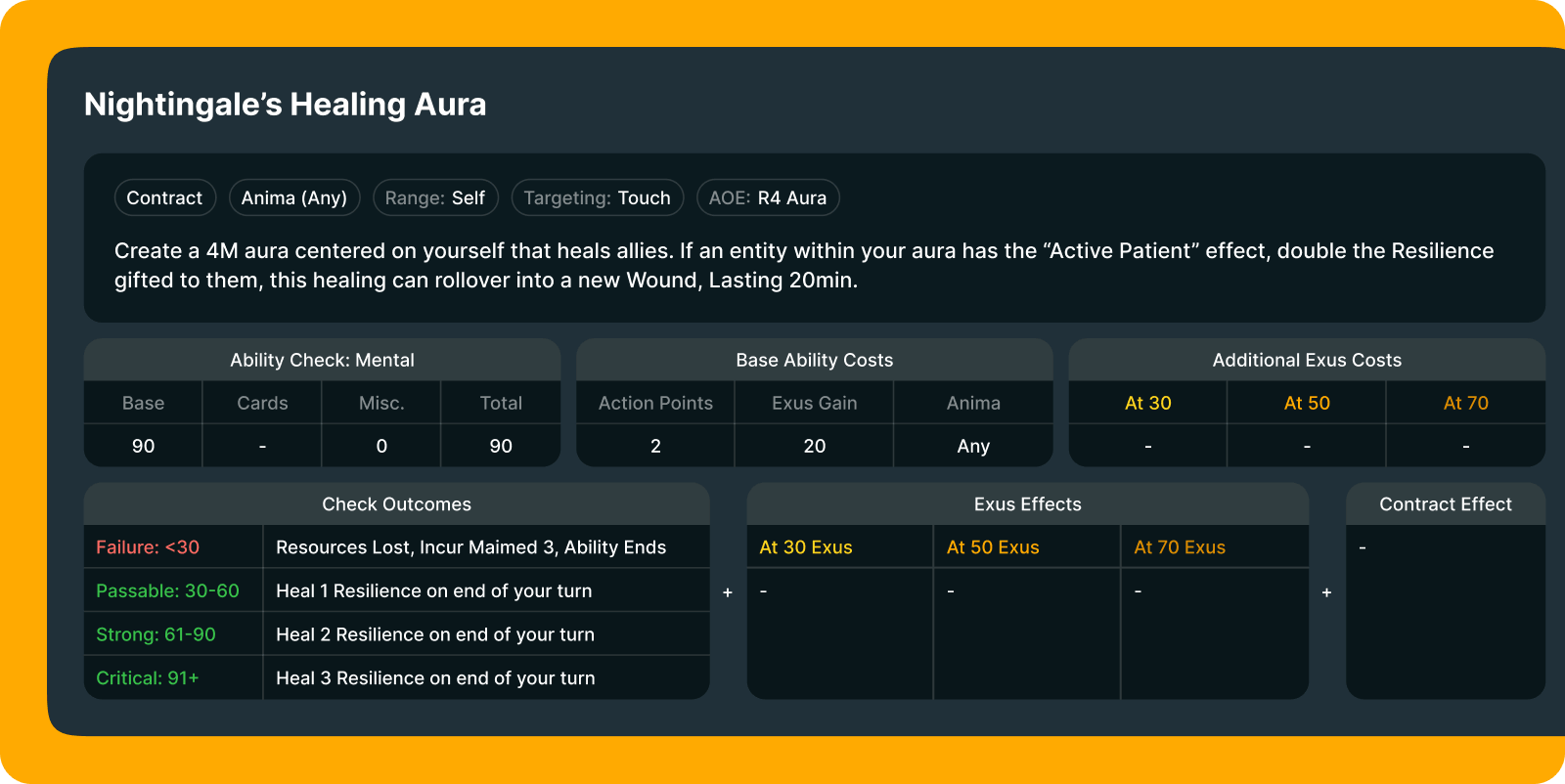
EDITORIAL: At time of publishing, Nightingale's Healing Aura has been nerfed. Press F.
Hank: Speaking of oddballs…Are there any oddball builds—using existing curricula—that you are eager to try? Feel free to mention relevant traits and weapons.
Colin: For oddball builds, I want to see more mixed weaponry specific builds. Like something with an Elemental Weapon and an Anima Cannon. You often do a lot of elemental MDMG with each and the buffs from the Elemental Weapon curricula stack really nicely. Plus, who doesn't want to wield the Caster from Outlaw Star?
Hank: Ahem! You mean something like the magical gun wielded by the notorious yet totally legally-distinct space pirate, Djinn Starwind? Yes, quite right.
Colin: Also, I think more Sensory magic focused users would be nice to see. There's a lot of possibilities in disruption of other people's casting, or causing illusions, distractions, and unusual crowd control abilities that I think would fit very nicely in most combats.
So often, combats tend to be a 3-to-4-on-1 opponent-to-player ratio. You might as well take advantage. Being able to disrupt the abilities of bosses and lieutenants is also huge and, overall, in tight competition with "unga-bunga big-bonk" kinds of builds.
Hank: Agreed, people are sleeping on sensory magic. There is a spell in Principles of Scent that literally lets characters smell lies. Nobody ever takes it, because "eww, nose stuff," but boy howdy is it useful.
Colin: Ready for some return questions?
Hank: Consider me strapped in. My body is ready.
Colin: Alright. So, unlike a lot of other Leading Brand TTRPGs you chose to go with a more modular class and magic system. What brought about this micro-classing idea vs. having each class with a more structured and focused design?
Hank: I think the prevalence of homebrew in Leading Brand TTRPGs says a lot about what players want. More personalization and originality. Characters who use unusual weapons or tactics that you have to run-by the GM before you can start the campaign. Outside of Baldur's Gate 3, I cannot remember playing a 5E or even a 3.5 campaign with anything other than a heavily homebrewed class or completely bespoke magic system. Hell, even in BG3, they have the Illithid stuff which is essentially the same thing. To say nothing of Durge! Anyway, I digress.
Really, I just love the feeling you get late-game in a Final Fantasy title where you have... dozens of distinct mechanical options. And I wanted to give players that rush right out of the gate. This is a bit apples-vs.-oranges, but imagine if you started a Metroidvania as if you were midway through the game in terms of power ups... and you still had the same kind of exponential growth to look forward to. This is our attempt to create the TTRPG version of that sensation.
Finally, it's born from the conceit of the world itself. Going back to my hackneyed "Magic as Music" metaphor. How many styles, songs, and instruments does a professional know how to perform? You need that kind of volume and granularity to get the most out of the "everything is magic" premise.
Colin: Absolutely. Considering how deeply magic is integrated into the world, there would be a lot of different aspects of it to be developed throughout.
Given how combat centric a lot of the curricula are, how do you see the more support type foundational classes integrating into a typical party?
Hank: Oh man. I usually play either a tank or a full-support in games that revolve around archetypal rolls. You know you have done support correctly when you feel like you turned the tide of battle. That's where the dopamine comes from. Like, a well-timed recovery spell, or a barrier that forces a bottleneck, or even a clutch buff on a unit with stronger damage potential? You not only appreciate it; the people you supported appreciate it. When people complain about support roles feeling thankless or useless, (both in real life and games,) the underlying system is usually at fault.
But "support" also means something special in a TTRPG context! You are the party's Swiss Army Knife for traps, locks, puzzles...and more narratively-oriented puzzles pertaining to whatever type of magic you are dealing with. Because our curricula are each so narrowly focused, we can really go nuts with abilities within those specialties.
So yeah, I think the spells we have both scratch that itch and fill that utility niche. The micro-class nature of the curricula system also blurs the lines between traditional DPS and Support. A character named Laine Mason proved just two nights ago that seemingly obligate supports can be hyper-carries when the circumstances line up just right.
[A pause paired with a thousand-yard stare.]
Hank: We are nerfing Nightingale.
Colin: Yeah, the sheer amount of spell slinging that came from a hedge witch was not expected. Let alone cracking Exus and just causing…. all kinds of hijinks.
Hank: I hate you.
EDITORIAL: Many Hedge Magick spells revolve around a status effect called Hijynx.
Colin: Speaking of Hedge Magicks… That's a pretty unique foundational class compared to the Amagiate classes. How was it balancing power levels and scaling a class that is supposed to be an "upstanding citizen," as opposed to an Amagia or an actual upstanding citizen?
Hank: Ha. You're gonna hate this.
Colin: Ruh-roh!
Hank: So you know my magic as music thing...
Colin: …I am familiar.
Hank: Yeah. I tried to make Hedge Witches' spell kit inherently Punk Rock. They disrupt the system so thoroughly, that they start with themselves. In terms of balancing against the amagiate starting classes... they are undeniably punching above their weight class. Two anima slots as opposed to six is brutal. Not being able to select much in the way of magic curriculum is also harsh. But I think that imbalance is a crucial element of Punk Rock. Kindness, too, I guess, whatever—but to me, being Punk means playing David to the world's Goliaths and the game needed to capture that.
From the start, we wanted to have that door open to people who want to challenge the Amagium in their campaigns. Down the road, we'll be writing specific scenarios with those premises, and we'll eventually be adding another Background that covers a completely civilian background. Law-abiding asfalis citizens, in way over their heads.
Colin: You know me, always looking forward to a deputized citizen ready to do their part and be a part of the machine, man!
EDITORIAL: This is a reference to Colin's original Anno Amagium character, Makk Guffin. Guffin is truly one of the characters of all time.
Colin: Has there been a specific mechanic or Ability that you were really excited about, and then once seen in practice it just goes absolutely bonkers beyond expectation? (Not Nightingale's.)
Hank: Many times. And it's almost always a good thing. Take Devere's ridiculous Jump Challenge rolls. He trivializes movement penalties like obstacles and exploitative attacks! Oh no! He can move 20 meters in a turn! The horror! And yet. The game still works. People still have a good time. I'd argue they have a better time because it's busted. In an inherently cooperative game, busted makes people happy. The thing about Nightingale's Healing Aura is that it also threatens boredom.
The tipping point between "we need to fix this" and "let it ride!" is long-term engagement. If something can bail you out of any situation, no matter what mistakes you have made... It kills the tension and players will get tired of that. I think the best kind of balancing is to allow those "broken" outcomes, but make them extreme edge cases. Feels good when it happens. Like a rolling a crit. But those outcomes become rare enough that they aren't disruptive.
Colin: Given that we're debuting with Adept and Advanced curricula which are only the first half of each curricula line… Can you give us a little teaser about what might show up for Expert and Master?
Hank: Oof. Saved the best for last, I see.
Colin: Gotta give them a little taste of what's to come!
Hank: So. This may disappoint some people, but Expert and Master will yield fewer spells and Techniques than the preceding curricula. (Expert will yield 5 spells, and Master will yield only 3.) This avoids padding out the spell lists with a bunch of "Advanced-Spell-But-Better" entries and it allows us to make the spells and techniques that are unlocked... much more impactful on the game world. I have an idea for a Master Swords technique... You essentially reverse-King Arthur a sword into an enemy. Does a ton of True Damage, and if it fells a reviving/regenerating foe, they stay defeated until the sword is withdrawn from their form.
Ah! Another tidbit. You'll notice that relatively few elemental spells yield summoning spells. Mostly just Earth, and secondarily crystal, and plants. All the cardinal elemental curricula and a good chunk of their derivative elements will also have familiar spells in their more advanced tiers. Aside from that, stay tuned!
Colin: Honestly, I'm really excited for that kind of design space and to get a good gear change from what we're currently building out to what can be seen in the (hopefully near) future.
There you have it folks! A totally not-forced conversation between two dudes about a game they just happen to be developing. Let us know if you enjoyed this one, and we will do more like it!