
Rules in Focus: Character Building - Traits
Turning Points Trump Fine Tuning
Traits in Brief
In Anno Amagium, a trait is exactly what it sounds like: a unique feature that distinguishes your character from people who have otherwise similar backgrounds, curricula, and loadouts. Traits are admittedly similar to many other character-building conventions in. Feats from Dungeons & Dragons, Perks from Fallout, and probably sundry others we haven't heard of.
Most systems have a single list of traits to choose from; sometimes gated behind specific species or sexes. In Anno Amagium, there are 4 subdivisions of traits. Foundational Traits, which include things like Attention Deficiency and Autism, are strictly for the sake of roleplaying and may serve as mixed blessings with a very minor mechanical impact on the game itself. Acquired Traits entail the vast majority of the Trait list, encompassing qualities your character was either blessed with at birth, or hallmarks of their hard-work. Heritage Traits make allowances for supernatural parentage, freeing players from the shackles of vanilla humanity. Finally, Special Traits can affect a campaign so significantly that they can only be granted with FM authority.
Broken Is Better
In any such system, a degree of unevenness is inevitable. There are certainly a few options in our collection of nearly 200 Traits that are more niche than others. But to combat “dump traits,” we went in with a relatively simple philosophy “every acquired trait should break rules.” Either in the sense of mechanical advantage or roleplaying satisfaction, and ideally, both.
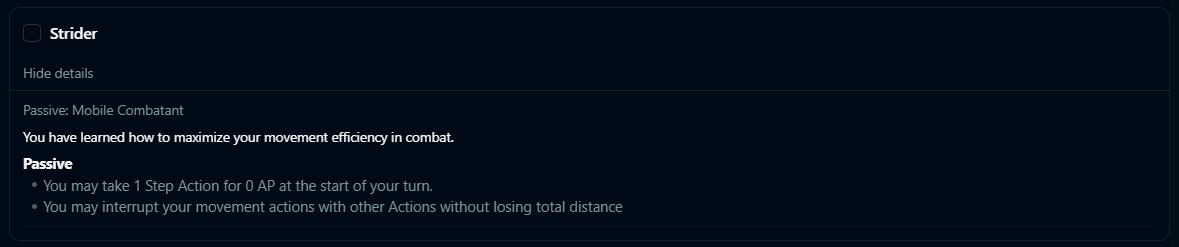
Let's look at a straight forward example. Above, you can see the alpha trait block for “Strider.” While receiving a free Step Action per turn is useful, it doesn't feel impactful enough to be an Anno Amagium trait. So we added another part to the Trait's passive that allows players to interrupt their Movement Actions with other Actions. Many games specifically disallow this because it can lead to some truly busted combat shenanigans. But one person's absurdity is another's power fantasy. If you want to be a hyper mobile fighter who can move from foe to foe, cutting them down with each attack, we want to facilitate that dream.
Temptation: The Bane of Determinism
Giving players a huge menu of tempting options also helps avoid the curse of a “mandatory trait,” something so important that it is required for a specific build, effectively taking away players' agency rather than giving them more options. The obvious potential example that springs to mind is Ambidexterity, because it is such a powerful steroid for characters who want to dual wield. Weapon-oriented traits, which grant Skill Bonuses, expanded critical ranges, and flavorful upgrades for their pertinent armaments, also toe the line of “insisting upon themselves” for current builds.
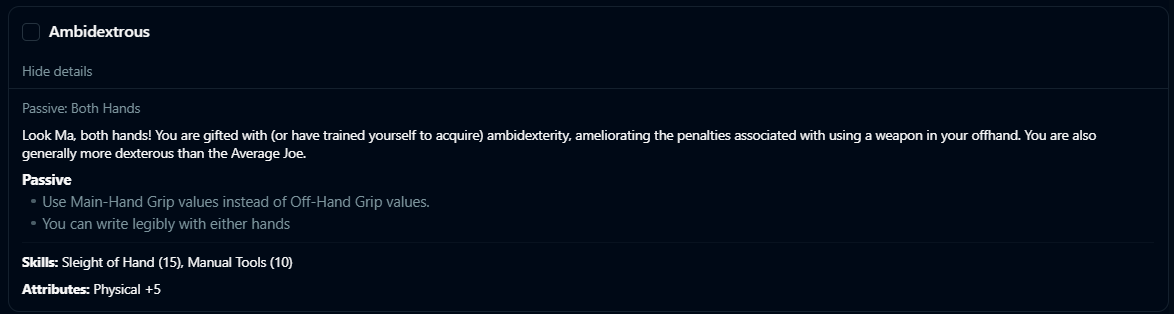
But you can still be an effective dual wielder by taking the Ryotoutsukai, Akimbo, or Duelist curricula. And when you are weighing some extra Strike and Crit Range for your specific weapons of choice against other huge advantages (new resources to re-do checks, an enhanced base damage bonus, or a substantial bump in resilience) the whole thing feels less like you are locked into a blueprint for the hero you want your character to become.
Creating Opportunities Instead of Waiting for Them
We've found the most fun way to break the rules is to allow players to use their traits proactively, creating new mechanical opportunities for themselves rather than bonuses that kick in when the stars align just right.
For that reason, many traits afford new actions, or in rare circumstances, unique resources. If a trait does provide a truly passive bonus, it should be something foundational that can affect every encounter. Taking one of our Attribute-boosting traits, for example, is the only way a character can exceed their starting stat limitations, ensuring you are a master at one particular type of spell or skill right out of the gate.
Situational bonuses can be extremely fun, but we find they work better as Curricular passives rather than character-defining traits. Curricula themselves are situational, whereas a Trait is something that shapes who you are personally. It is a defining feature that other party members will recognize your character by.
Anti-Handicaps as Teaching Tools
Returning to our Strider example, Traits can also serve as an excellent way to learn the game. If a player is having trouble keeping track of the flow of turns, or misjudging the AP wasted by an unnecessary movement action, Strider instantly alleviates that tension by negating those restrictions.
Another personal favorite fulfils a similar purpose, but for roleplaying. Every tabletop group has had a player who is reading averse, but eager to participate. People who prefer to learn the lore first-hand rather than reading a rulebook or packet. Enter the Isekai'd Trait. This player will behave as if they were spirited away to the world of Anno Amagium from our version of Earth. They will have no knowledge of wyrds, magic, amagia, etc., but now the stage is set for them to learn on the goal.

It is worth noting; Isekai'd is a Special Trait, meaning that it can only be bestowed with FM approval, as such traits can be disruptive to the story, and not all FMs want to deal with that. Other Special Traits, like therianthropy curses, or vampirism can be bestowed upon players after major milestones in the story. These even-more-impactful Traits give players and FMs more tools to build their heroes and tell the stories they want.
More Than Mechanical Advantages
Some traits heavily favor roleplaying dynamics as opposed to combat. These traits may appear less exciting than options that will make you a combat god… but a well-played conversation can change the course of an entire campaign. Take the trait Polyglot for example:
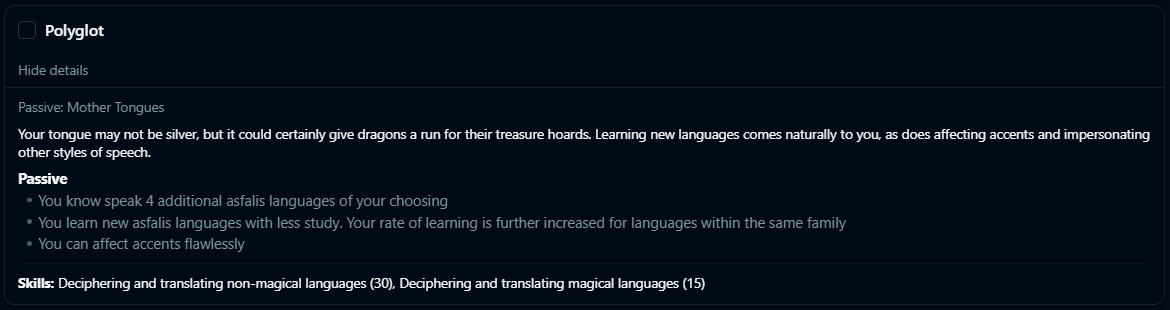
Seems unassuming enough, right? Speaking many languages is characterful, sure, and it can be very useful depending on where your campaign is located. But that last little bit there “this character may affect accents flawlessly,” has enormous potential for subterfuge and negotiation.
One of our beta parties cleared a safehouse of Colombian chimera-breeders and discovered the defeated lieutenant's phone. When the criminals' allies called the party, the Polyglot answered the phone. Even though Columbian was not one of the “extra” languages chosen, the Polyglot was able to bluff his way out of a retaliatory kill squad, and extract invaluable information from the antagonists with a phone conversation. All because of their ability to pick up and emulate accents.
A Matter of Heritage
In Anno Amagium, supernatural creatures play by very different rules than humans. They not only have different biological quirks, but they have fundamentally different ways of perceiving the universe. Some have hive minds. Others experience time itself differently. And many, including Fae, are semi-immortal. Strictly speaking, they are not people, but something inherently “other,” and for that reason, to start, we are restricting player characters to the human race. Just because you're stuck as a skin-ape doesn't mean you have to be boring about it, however.
Enter Heritage Traits. Humans can interbreed with natural-born vampiric monstrum, humans afflicted by vampiric curses, and different faen races (with even more options planned in the future). Currently, players can choose between 8 different vampire heritages, and 15 different faen races, each with 5 variations depending on their Seasonal Court. You cannot be a half-fae, half-vampire, however. (Human offspring from mixed unions are almost always sterile.)
If the idea of looking like a plain human in a fantasy game makes you cringe, your mother could be a flower person (Florem) from the Spring Court, or you could have been sired by an Alukanah vampire, or you could hail from a (half) lineage of Winter Court Gnomes, and so forth. These unique heritages give you carte blanche to adjust your character's appearance in flavorful ways that reflect your personal fantasy, and come with flavorful rules that will shape the way you interact with the world in your campaign.
Be Who You Want
And there you have it. Traits in a nutshell. Our ultimate goal is to ensure players have many appealing options to develop their unique concepts, while steering the conversation away from pre-determined advancement flowcharts. Character building is always the most fun when you have difficult choices to make, and you anticipate future growth so you can select all the options you want for your character. Aspiration and anticipation are huge parts of what makes roleplaying great, and we want to facilitate them as much as possible.